English
Best At-Home Blood Test Kits in Canada Reviewed

Introduction
Finding an at-home blood test Canada provider that delivers reliable, physician-reviewed results is now a realistic option for health-conscious Canadians in every major city. Long wait times in the public healthcare system have pushed thousands of people toward private preventive blood testing Canada services that arrive at their doorstep. The challenge is determining which provider offers the best combination of biomarker depth, accuracy, turnaround speed, and value. This review compares the leading home blood test kit Canada options available today, breaking down exactly what each service measures and how they stack up against one another.
Key Takeaway: The best at-home blood test kit for most Canadians is one that combines 50+ biomarkers, physician oversight, clear digital reporting, and nationwide availability, with Biomi's Peak plan standing out as the strongest overall value in this category.
What to Look for in a Home Blood Test Kit
Not all at-home blood testing services are created equal. The differences between providers often come down to a handful of critical factors that directly affect how useful the results will be for your preventive health journey.
Key Evaluation Criteria
When comparing top blood testing services Canada-wide, these five criteria separate a genuinely useful service from a basic screening that tells you very little.
Biomarker count and depth: Services testing 50+ markers give a far more complete picture of cardiovascular, metabolic, hormonal, and thyroid health than basic panels covering only 10 to 20.
Physician review: Any reputable service should include a licensed physician reviewing your results before delivery, ensuring clinical accuracy and flagging anything requiring follow-up.
Result delivery and dashboard: Look for secure online portals that show longitudinal trends, not just one-time PDF reports that are difficult to act on.
Collection method and convenience: Some kits use finger-prick capillary samples while others offer phlebotomist-attended at-home blood draws, which yield venous samples suitable for broader testing panels.
Geographic availability: Confirm the service covers your province, as some providers are limited to Ontario or British Columbia only.
At-Home Blood Test vs. Traditional Lab Visit
The most common question Canadians ask is whether a home blood test kit Canada option can match the accuracy of a traditional lab visit. The short answer is yes, when the service uses accredited laboratory partners and venous blood collection rather than finger-prick-only methods. A large-scale Canadian study demonstrated the feasibility of self-collection blood testing with over 10,000 participants, confirming that properly designed at-home kits produce clinically usable samples. The real advantage of at-home testing is eliminating the scheduling friction, commute time, and multi-week waits that characterize clinic-based lab visits. For people in Toronto, Vancouver, or Ottawa who need wellness blood work without disrupting their workweek, home collection removes the primary barrier to consistent health screening.
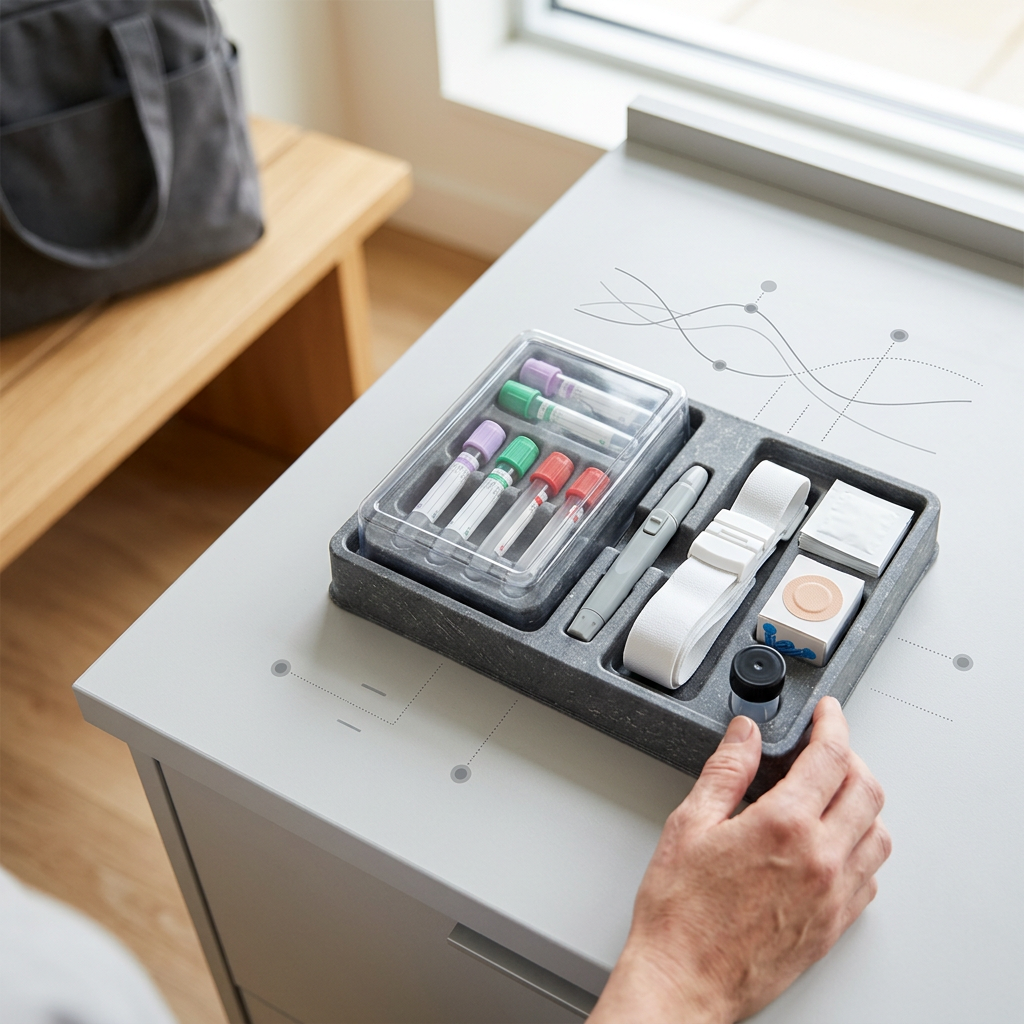
Comparing the Best At-Home Blood Test Services in Canada
The Canadian market now includes several health screening at-home Canada providers. Each targets slightly different user needs, from basic wellness snapshots to comprehensive optimization panels. The comparison below focuses on the factors that matter most for making an informed decision.
Provider Comparison Table
This table summarizes how leading Canadian at-home blood testing services compare across the criteria that determine real-world utility for preventive health management.
Feature | Biomi (Peak Plan) | Provider B | Provider C |
|---|---|---|---|
Biomarkers Tested | 60 (heart, thyroid, hormonal, metabolic) | 30 to 40 | 15 to 25 |
Collection Method | Venous draw at home | Finger-prick self-collection | Finger-prick self-collection |
Physician Review | Yes, included | Optional add-on | No |
Digital Dashboard | Longitudinal tracking with health scores | One-time PDF report | Basic online results |
Biological Age Assessment | Yes | No | No |
Coverage Area | Nationwide (major cities) | Ontario and BC only | Ontario, Alberta, BC |
The standout differentiator is biomarker depth paired with physician oversight. Services offering fewer than 40 markers often miss thyroid, hormonal, and inflammatory indicators that are critical for catching issues early. Biomi covers 60 biomarkers with its Peak plan and includes biological versus chronological age comparison, giving users a single metric to track overall aging trajectory. For Canadians investing in affordable blood testing options, a service that skips physician review creates a gap where abnormal results go uninterpreted.
Understanding Biomarker Depth and Panel Types
A comprehensive blood panel typically includes complete blood count, lipid profile, metabolic panel, thyroid function, inflammatory markers, iron studies, and hormonal indicators. Basic panels might only cover CBC and a limited metabolic snapshot, missing critical signals like elevated CRP, suboptimal vitamin D, or thyroid irregularities that present no obvious symptoms for years. Research into user experience considerations for at-home blood testing consistently shows that patients prefer receiving comprehensive, clearly explained data rather than minimal markers without context.
For anyone comparing biomarker testing across provinces like Alberta, British Columbia, or Ontario, the key question is whether the panel covers enough ground to detect early-stage metabolic dysfunction, cardiovascular risk factors, and hormonal imbalances simultaneously. A panel testing 60+ markers does this. One testing 15 to 25 does not. If you want to understand what a full blood panel includes, start by confirming that thyroid (TSH, T3, T4), inflammatory (hs-CRP), and hormonal markers (testosterone, estradiol, cortisol) are present alongside standard metabolic indicators.

Conclusion
Choosing the best at-home blood test Canada service comes down to biomarker depth, physician involvement, and the quality of result interpretation. For most health-conscious Canadians, a 60-biomarker panel with physician review and longitudinal digital tracking represents the sweet spot between clinical thoroughness and practical convenience. Start by confirming that your chosen service covers your province, uses venous collection for maximum accuracy, and provides actionable guidance rather than raw numbers. Making preventive blood work a consistent habit, rather than a one-time curiosity, is what transforms data into meaningful health improvements over time. The Canadian Health Measures Survey methodology confirms that population-level health gains are driven by consistent measurement, and the same principle applies at the individual level.
Frequently Asked Questions (FAQs)
How does at-home blood testing work in Canada?
A licensed phlebotomist visits your home to collect a venous blood sample, which is then shipped to an accredited lab for analysis, with results typically available within 3 to 7 business days through a secure online portal.
Can you do blood tests at home in Canada?
Yes, several private services now offer physician-ordered blood tests with at-home collection across major Canadian cities including Toronto, Vancouver, Montreal, and Ottawa.
How accurate are home blood tests?
At-home blood tests using venous collection and accredited laboratory partners deliver accuracy equivalent to traditional clinic-based draws, as the sample handling and analysis protocols are identical.
Is home blood testing covered by insurance in Canada?
Most provincial health plans do not cover private at-home blood testing, but many extended health benefits and health spending accounts (HSAs) will reimburse the cost depending on the employer plan.
What does a comprehensive blood panel include?
A comprehensive panel typically includes 50 to 65+ biomarkers spanning complete blood count, lipid profile, metabolic panel, thyroid function, inflammatory markers, iron studies, vitamin levels, and hormonal indicators.
How often should I get blood work done?
For proactive health monitoring, testing every 3 to 6 months provides enough data points to identify trends early, though annually is a reasonable minimum for generally healthy adults.
How does Biomi compare to a traditional lab visit in Canada?
Biomi uses the same accredited lab infrastructure as traditional clinics but adds at-home venous collection, physician-reviewed results with personalized health scores, and a longitudinal tracking dashboard that standard lab requisitions do not provide.
About the author

Medical Research Content Advisor
Combines medical research and functional medicine expertise to create educational content on health biomarkers, disease prevention, and longevity.
Related articles
- Biological Age Blood Test: What It Measures and Why It Matters
Curious about your biological age blood test results? Explore key biomarkers, what they reveal, and how to start optimizing your longevity today.
- At-Home Blood Draw for Health Testing in Calgary: How It Works
Discover how at-home blood draw testing works in Calgary, from booking to physician-reviewed results. Book your mobile blood collection today.
- What Is Biomi? Biomarker Testing and Biological Age Explained
Discover what Biomi is and how biomarker tracking reveals your biological age vs chronological age. Start your health journey today.
- Home Blood Draw: What to Expect Before Your Appointment
Booking a home blood test? Learn exactly what to expect before your appointment, from prep tips to physician-reviewed results with Biomi.
- What Is Longevity Testing? How It Works and What to Expect
Curious about longevity testing? Learn how this biomarker blood test works, what to expect, and how it reveals your biological age. Start today.
Read article: Biological Age Blood Test: What It Measures and Why It MattersRead article: At-Home Blood Draw for Health Testing in Calgary: How It WorksRead article: What Is Biomi? Biomarker Testing and Biological Age ExplainedRead article: Home Blood Draw: What to Expect Before Your AppointmentRead article: What Is Longevity Testing? How It Works and What to Expect